
The Digital Patient File: What Actually Belongs on One Screen
A split patient record is a clinical risk, not just an admin annoyance. What a complete dental record contains, what duplicate files quietly break, and how to judge a system before you migrate.
Published
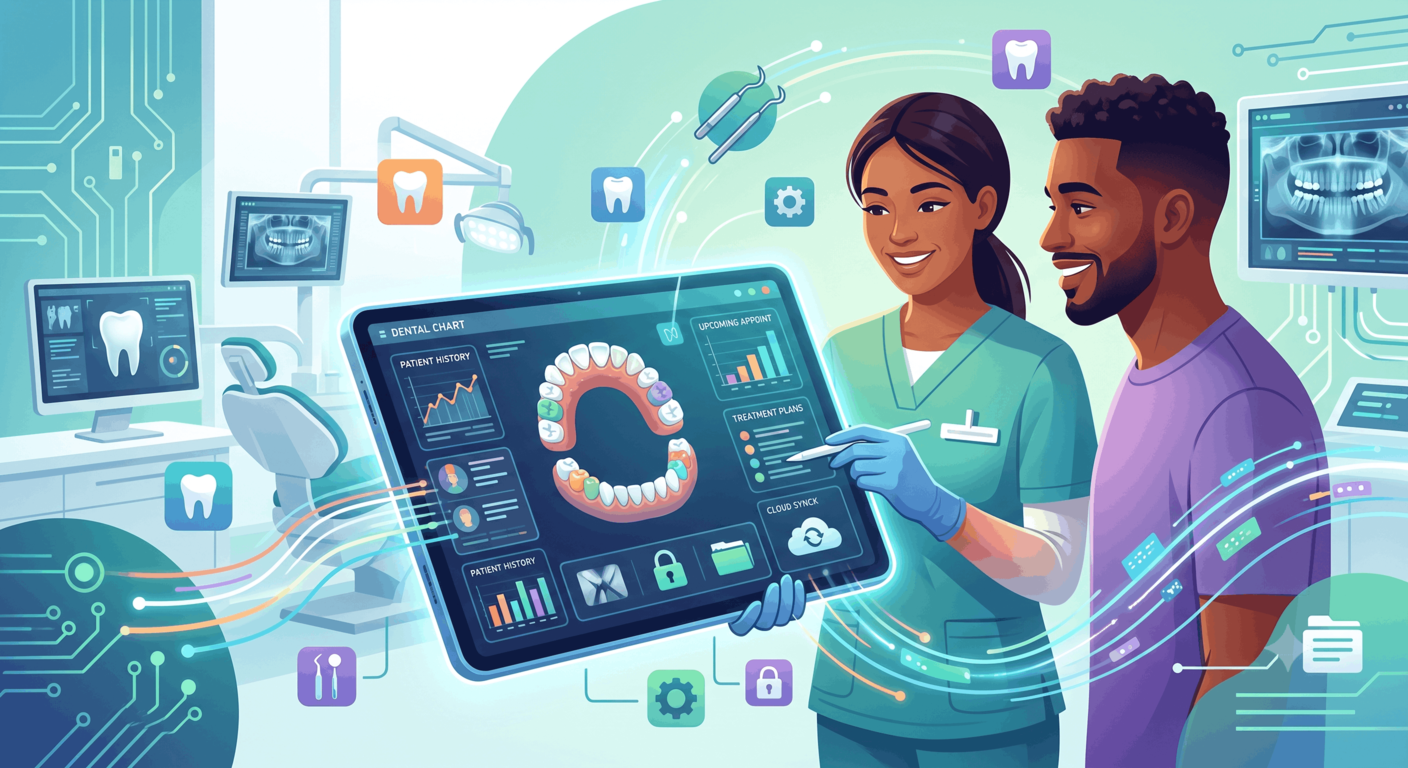
Ask a dentist what slows them down mid-appointment and very few will say data entry. What they describe instead is hunting: the last radiograph is in a folder, the treatment plan is in a different tab, the balance is something reception knows, and the allergy note is on a form somebody scanned two years ago.
Each individual lookup costs a minute. What it actually costs is attention — and attention is the thing you are supposed to be spending on the patient in the chair.
What a complete record contains
A digital patient file is not a scanned version of your paper one. The test is whether a clinician can make every decision an appointment requires without leaving the screen. That means:
- An interactive dental chart with per-tooth history — not a static picture, but a record of what was done to which surface and when, including endodontic detail like canal measurements where relevant.
- Medical history and allergies, visible without being clicked into. This is the one field where "it was in the system" is not a defence.
- Prescriptions, with the ability to reissue from a template rather than rewrite.
- Attachments — radiographs, consent forms, referral letters, before-and-after photographs.
- Insurance position — which company, which coverage period, what limit remains.
- The financial ledger — procedures, payments, discounts and the outstanding balance, in one place rather than reconstructed from receipts.
The list is unremarkable. What matters is that all of it is the same record, not six systems that happen to describe the same person.
The three failures a split record causes
Clinical decisions made on partial information
If the treatment history and the radiographs live apart, the history wins by default, because it is the one that is easier to open. Most of the time that is fine. Occasionally it is not, and the cost of "occasionally" in dentistry is high.
The front desk quoting a number that isn't true
A patient asks what they owe. If the answer requires adding a spreadsheet to a receipt book, the number given will sometimes be wrong — and a wrong number quoted confidently is worse than "let me check", because the patient will hold you to it.
Reporting that describes a clinic you don't have
Retention, lifetime value and drop-off all depend on knowing that this patient is the same patient as last year. Split records make a returning patient look like a new one, which quietly inflates your acquisition numbers and hides your retention problem. You end up spending on marketing to solve what is actually a recall problem.
Duplicate records: the failure that compounds
Duplicates are worth their own section because they are the one data problem that gets worse with time, and because almost every clinic has them.
They arrive innocently. A patient books by phone under a shortened name, then again online with their full name. A married patient's surname changes. Two staff create a file within the same minute. A patient visits your second branch and nobody checks.
Once there are two files, every subsequent visit deepens the split. Six months on, merging them means reconciling two treatment histories and two ledgers — which is exactly the sort of job that gets postponed indefinitely.
| What breaks | Consequence |
|---|---|
| Treatment history | The dentist sees half of it |
| Financial ledger | Balance is understated; collection misses it |
| Insurance limit | Patient appears to have more coverage than they do |
| Recall and follow-up | Reminders go to one file, treatment to the other |
| Reporting | One person counted as two new patients |
The fix is prevention, not cleanup: detection at the point of creation, so the system flags a likely duplicate while the receptionist is still typing.
How to judge a system before you migrate
Migration is the moment you are most locked in, so evaluate before rather than after. Four practical tests:
- The two-click test. From the appointment, how many clicks to see what was done last visit and what the patient owes? More than two and clinicians will stop bothering.
- The allergy test. Is critical medical history visible without being opened? If it is behind a tab, it will be missed one day.
- The duplicate test. Create a patient with a near-identical name. Does the system warn you, or cheerfully create a second file?
- The migration scope question. Ask specifically what comes across: patients only, or treatment history, balances, attachments and insurance periods too? "We'll migrate your data" is not an answer — get the list.
How PDental handles it
PDental keeps the clinical and financial sides of a patient in the same record rather than in linked systems. The patient screen carries the interactive dental chart with per-tooth notes, treatment history, medical history, prescriptions and attachments, alongside the ledger of procedures, payments and outstanding balance, and the patient's insurance approvals, coverage periods and remaining limit.
Duplicate detection runs against the patient list so near-matches surface as a warning rather than becoming a second file — and because the record is shared across branches, a patient seen at a second location is the same patient, with one history, one balance and one insurance position rather than two of each.
That last point matters more than it sounds. It is the difference between opening a second branch and opening a second database.
The honest summary
Most clinics do not need a better filing system. They need to stop having several. The value of a digital patient file is not that it is digital — scanned paper is digital and helps nobody. It is that there is exactly one of it, it opens in one place, and everyone who touches the patient is looking at the same thing.
Get that right before you optimise anything else. Every other module — scheduling, insurance, reporting — is downstream of the patient record being trustworthy.
Frequently asked questions
What should a complete digital dental patient record contain?
Everything needed to make a decision at the chair without leaving the screen — an interactive dental chart with per-tooth history, medical history and allergies, prescriptions, attachments such as radiographs and consent forms, insurance coverage and remaining limit, and the financial ledger of procedures, payments and balance. If any of those live in another system, someone will eventually act without them.
Why are duplicate patient records such a problem?
{ "Because a patient who exists twice has two of everything": "two treatment histories, two balances and two views of their insurance limit. The dentist sees half the clinical picture, the front desk quotes the wrong balance, and reporting counts one person as two new patients. It is one of the few data problems that gets worse rather than better with time." }
Is it safe to move years of paper records into a new system?
The risk is not the move, it is an incomplete move. Decide deliberately what gets migrated in full, what gets attached as scanned documents, and what stays archived — and write that policy down before starting, so nobody has to guess halfway through which patients were done.
Does a digital record slow clinicians down during the appointment?
Only if it makes them hunt. A record that opens on one screen with chart, history, balance and documents together is faster than paper. The measure to apply when evaluating a system is how many clicks it takes to answer "what did we do last time and what does this patient owe" — if that is more than two, the design is wrong.