
How to Cut Dental Clinic No-Shows Without Hiring More Front-Desk Staff
Empty chair time is the most expensive problem in a clinic that looks healthy on paper. Why it happens, five operational changes that recover it, and how to measure whether any of them worked.
Published
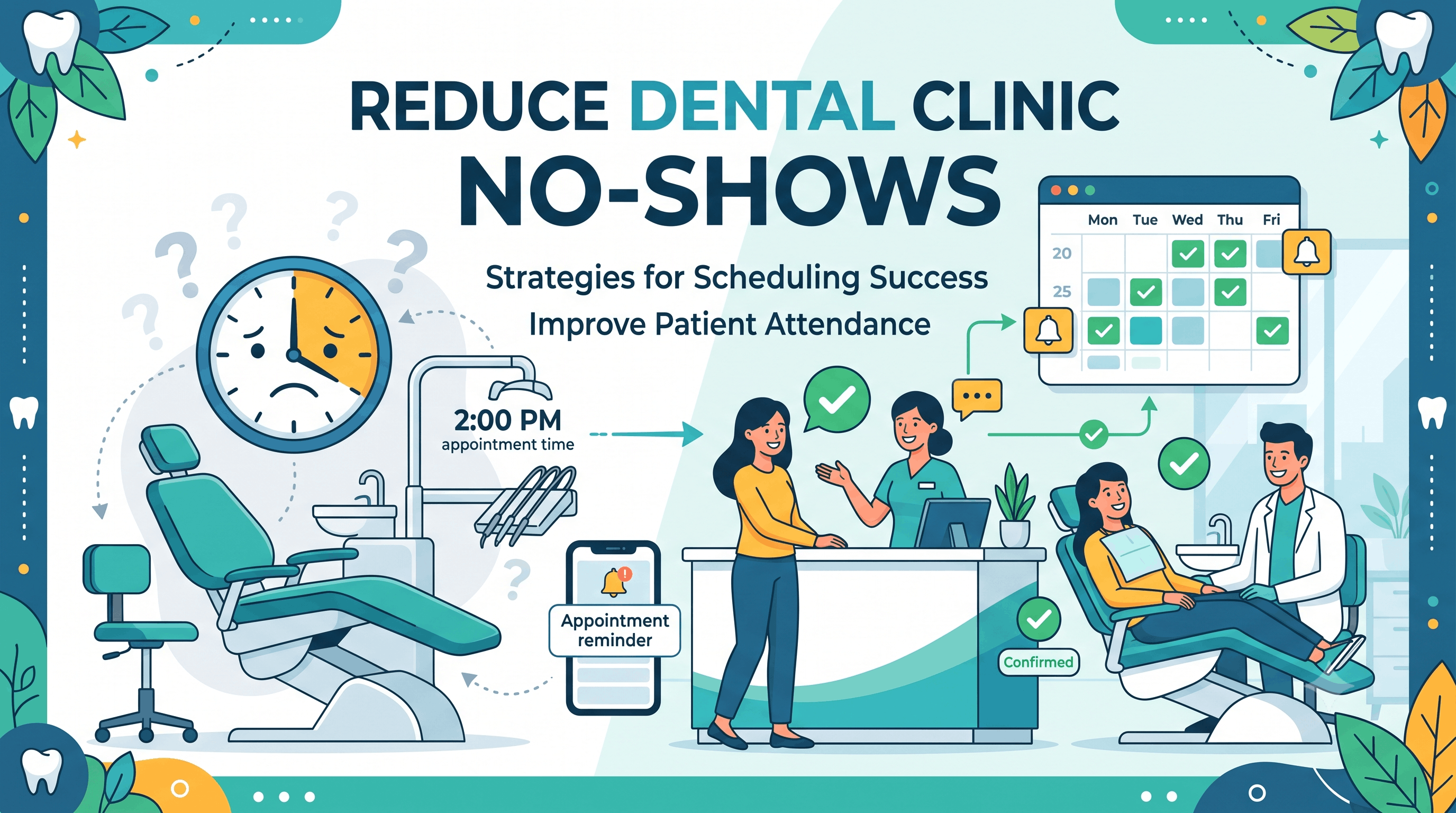
A no-show is not a gap in the diary. It is a fixed cost with no revenue against it. The chair was reserved, the assistant was rostered, the rent was paid, the sterilisation cycle was run. Every one of those costs is incurred whether or not the patient walks in.
That is what makes empty chair time the most expensive problem in a dental clinic that looks, on paper, like it is performing well.
Do the arithmetic on your own clinic first
Before changing anything, work out what the problem is actually worth to you. The calculation is simple:
Average value of a procedure × empty slots per week × 48 working weeks
For a clinic averaging 700 in procedure value that loses six slots a week, that is a little over 200,000 a year in capacity that was staffed and paid for but never billed. Adjust the numbers to your own averages — the point is not the figure in this example, it is that most owners have never run the multiplication and are surprised by the result.
Two things follow from doing it. First, the problem is almost always larger than it feels, because each individual no-show is small and forgettable. Second, it gives you a budget: you now know what it is rational to spend on solving it.
Why chairs sit empty
The reminder depends on somebody remembering
In most clinics, reminders are a task on a person. When reception is calm, reminders go out. When two patients are waiting, the phone is ringing and an insurance approval needs chasing, they do not. The reminders that get skipped are the ones sent during your busiest periods — which are precisely the days whose slots are most valuable.
This is not a discipline problem. It is a design problem. Any process that competes with live patients for the same person's attention will lose.
The reminder arrives somewhere nobody reads
A reminder that is technically sent but never seen has the same value as no reminder. If your clinic still relies on a phone call to a landline or an SMS that lands in a filtered inbox, a significant portion of your reminders are being delivered into a void.
The channel matters more than the message. In most Gulf markets, a WhatsApp message will be read within minutes; the same text as an SMS may never be opened.
Cancellations are treated as bad luck rather than data
Most clinics record that a patient did not attend. Very few record the pattern. Yet no-shows are rarely evenly distributed — they cluster by time of day, by treatment type, by doctor, by how the patient found you, and by whether the patient has an outstanding balance.
Until you can see that distribution, every fix is a guess.
Five changes that recover chair time
- Automate the reminder so it cannot be skipped. Move reminders off a person's task list and onto a rule tied to the appointment itself. The reminder should fire because an appointment exists, not because someone had a quiet moment.
- Send it where the patient actually reads. Default to WhatsApp where your patients use it, with SMS as a fallback. Support both rather than standardising on the cheaper one.
- Make confirming a single action. A reminder that asks the patient to call you back to confirm adds friction and will be ignored. A message they can simply reply to converts far better — and a reply is a much stronger signal of intent than silence.
- Build a standby list you can actually action. When a cancellation arrives 18 hours out, the slot is only recoverable if you can see, in seconds, which patients wanted an earlier appointment. That means a real waiting list attached to the calendar, not a note in a drawer.
- Measure cancellations by segment before you change anything else. Break the rate down by doctor, treatment, day, time and referral source. Fix the biggest cluster first. A clinic that discovers 40% of its no-shows sit in one doctor's late-afternoon slots has a scheduling problem, not a messaging problem.
Manual versus automated: what actually changes
| Manual process | Automated process | |
|---|---|---|
| Reminder sent | When reception has time | Always, on a rule |
| Busy-day coverage | Drops exactly when slots are most valuable | Unaffected |
| Channel | Usually one, whatever is habitual | WhatsApp with SMS fallback |
| Confirmation | Patient must call back | Patient replies to the message |
| Proof it was sent | Memory, or nothing | Message log with delivery status |
| Cancellation analysis | Anecdotal | Segmented by doctor, time, treatment |
| Refilling a slot | Ring round from memory | Standby list against the calendar |
The right-hand column is not more effort than the left. It is less — the work moves from your team to a rule that runs whether anyone remembers it or not.
How PDental handles it
PDental treats reminders as a property of the appointment rather than a job for the front desk. Configurable message types fire on the events you choose — booking confirmation, pre-visit reminder, post-visit follow-up — over WhatsApp and SMS, and every message is written to a log with its delivery status, so when a patient insists they were never told, you can show them exactly what was sent and when.
The measurement side matters just as much. PDental ships dedicated reporting for appointment cancellations, appointment duration and peak hours, so you can see where your empty slots concentrate rather than inferring it. Pair that with room and doctor schedule utilisation reporting and you get an honest picture of how much of your capacity is actually being sold.
Because the same system holds the patient record, the calendar and the messaging, a cancellation, a refill and a follow-up are all one flow rather than three disconnected tasks.
Where to start
Pick a single month and measure honestly: how many booked slots went unfilled, and what were they worth. Then segment that number once. Almost every clinic finds one dominant cluster — one doctor, one time band, one treatment type — and fixing that single cluster usually recovers more chair time than a general campaign of reminders ever would.
Automate the reminders because they should never have depended on a person. But start with the measurement, because that is what tells you which problem you actually have.
Frequently asked questions
How far in advance should appointment reminders be sent?
{ "A two-message pattern works well for most clinics": "one confirmation at booking, then one reminder 24 to 48 hours before the appointment. The second message is the one that matters, because it arrives while the patient can still realistically rearrange their day, and while you can still refill the slot if they cancel." }
Do WhatsApp reminders work better than SMS for dental clinics?
In most Gulf and wider MENA markets, yes — WhatsApp is read far more reliably than SMS, and it supports a reply, which turns a one-way notification into a confirmation. SMS remains a useful fallback for patients who do not use WhatsApp, so the practical answer is to support both and let the patient's history decide which channel to use.
What no-show rate should a dental clinic aim for?
Rather than chasing a published benchmark, measure your own rate for a month, segment it, and target a reduction against that baseline. Your realistic floor depends on your patient mix, treatment types and location, so your own trend line is a far more useful target than an industry average.
Can reminders alone fix a high no-show rate?
Not on their own. Reminders address forgetfulness, which is only one cause. If a specific doctor, treatment type, time slot or referral source is producing most of your no-shows, the fix is operational rather than communicational — which is why measuring cancellations by segment matters before you change anything.