
Opening Your Second Clinic: The Eight Numbers You Need on One Screen
A second location does not double the work of running one — it changes the job entirely. Here is what breaks first, and the eight metrics that keep a multi-branch dental group manageable.
Published
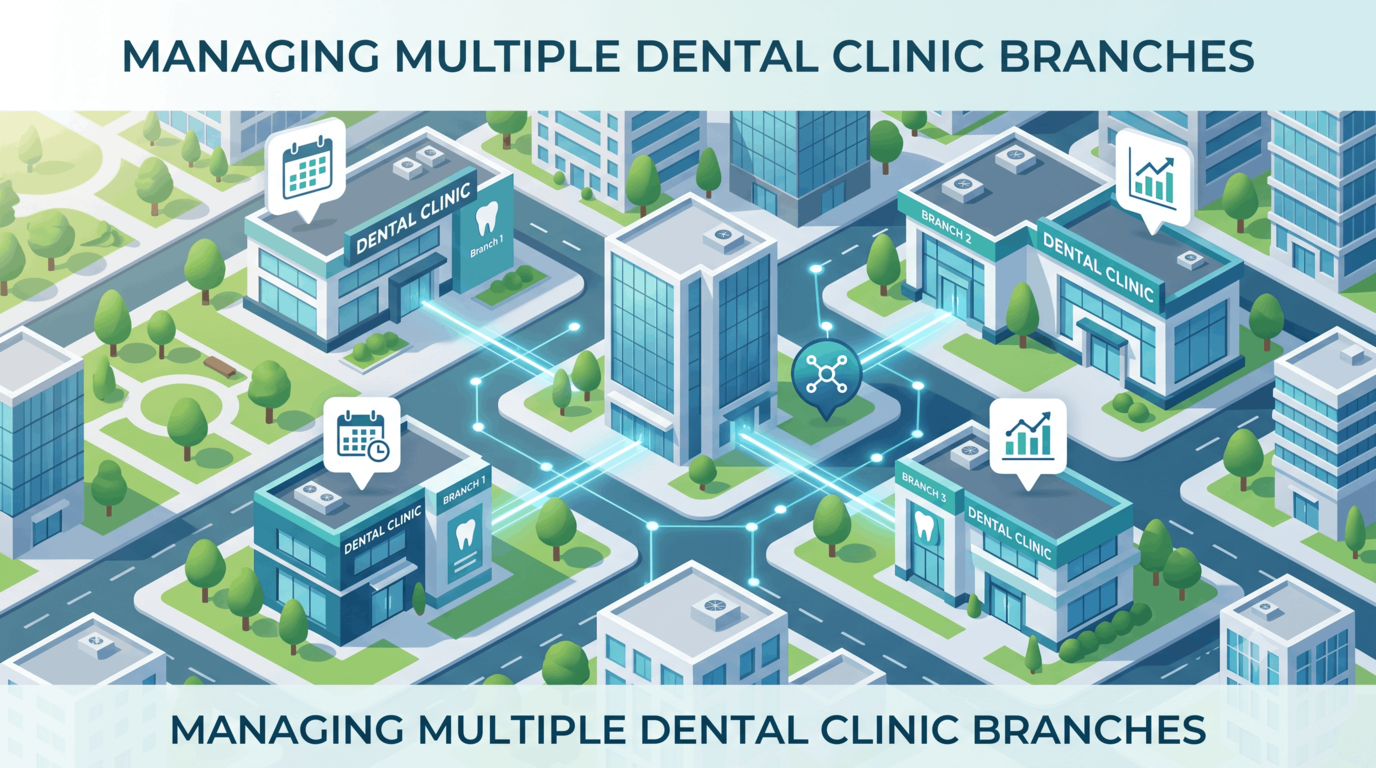
The pitch for a second location is straightforward: you already know how to run a clinic, so run another one. Double the chairs, double the revenue.
What actually happens is that the job changes. Running one clinic is an operational role — you are in the building, you see the waiting room, you notice when a chair sits empty. Running two is an information role. You cannot see either building properly, so you are managing from reported numbers instead of observation, and any weakness in those numbers becomes a weakness in your decisions.
Most groups that struggle at two or three locations are not struggling with dentistry. They are struggling because the reporting was never built for it.
What breaks first
Informal knowledge stops working
In a single clinic, an enormous amount runs on shared understanding. What we charge for a composite. When we offer a discount. How we handle a patient who is three months overdue for a recall. How much composite we keep on the shelf.
None of that is written down, and it does not need to be — everyone is in the same building. The moment there are two buildings, those undocumented practices begin to drift, quietly and in different directions. A year on, you have two businesses under one brand, with different pricing, different recall discipline, and different stock levels.
Comparison becomes impossible
Your instinct is to compare branches, and your instinct is right. But comparison only works if both branches record things the same way. If one books a hygiene visit as a 30-minute slot and the other as 45, their utilisation figures are not comparable. If one records a treatment plan as a single procedure and the other itemises it, their procedure counts are not comparable either.
Standardising how things are recorded matters more than any dashboard you put on top.
The strong branch subsidises the weak one invisibly
Group-level revenue looks fine. Underneath it, one location is carrying the other. Without per-branch profitability you will not see this for a long time — and by the time you do, the underperforming location has usually consumed enough cash to make closing it painful and fixing it slow.
The eight numbers
These are the metrics that, in combination, tell you whether a multi-branch group is healthy. The point is not that they are exotic — it is that you need all eight, per branch, in one place.
- Chair and room utilisation. The percentage of available chair time actually sold. This is the closest thing to a single measure of operational health, because it captures scheduling quality, no-shows and demand at once.
- Revenue per branch, against its cost base. Not group revenue. Each location's revenue set against its own rent, staffing and stock — otherwise a strong branch will mask a weak one indefinitely.
- Cancellation and no-show rate. Segmented by doctor and time band. A branch with high utilisation and a high no-show rate has a demand problem hiding behind a full-looking diary.
- New patients versus returning patients. A branch growing only on new patients has a retention problem that will surface the moment marketing spend pauses. The ratio matters more than either number alone.
- Outstanding patient balances, aged. Money owed by patients, bucketed by how long it has been owed. This is the fastest-moving cash figure in the practice and the one most often left unwatched.
- Insurance claims ageing. Submitted, unpaid, and how long it has been sitting. See the five places clinics leak insurance revenue — at two branches, that leak doubles quietly.
- Doctor productivity. Revenue and procedures per clinical hour worked, per doctor. This is the number that tells you whether a branch has a capacity problem or a performance problem, which are solved very differently.
- Stock and lab turnaround. Low-stock forecast and average lab turnaround per location. These are the two operational failures patients actually notice, and they are almost always worse at the newer branch.
Group view versus branch view
| What the group view answers | What the branch view answers | |
|---|---|---|
| Utilisation | Do we need more capacity anywhere? | Which branch is selling its chairs? |
| Revenue | Are we growing? | Which location actually earns? |
| No-shows | Is our reminder process working? | Which doctor or slot is the problem? |
| Retention | Is the brand holding patients? | Which branch loses them? |
| Balances | What is our total exposure? | Where is collection failing? |
| Productivity | Do we have enough clinicians? | Who needs support, who needs load? |
The mistake is running only the left column. Group totals are reassuring and non-actionable; a group can look stable while one branch quietly deteriorates. The right column is where decisions live.
Standardise before you scale
The clinics that handle a third and fourth location well almost always did the same unglamorous work before opening the second:
- One price list as the source of truth, with any per-branch variation deliberate and recorded rather than accidental.
- One definition of an appointment type and its duration, so utilisation is comparable.
- One recall and follow-up policy, executed by the system rather than by whoever remembers.
- Branch-scoped permissions, so staff see their own location while owners keep the consolidated view.
- One shared patient record, so a patient who visits the other branch is the same patient, not a duplicate.
That last point sounds obvious and is routinely got wrong. A patient who exists twice has a split treatment history, a split balance, and two different views of their insurance limit.
How PDental handles it
PDental is multi-clinic and multi-branch by design rather than by extension, which means branch is a property of the data rather than something layered on afterwards. Rooms, price lists, permissions and stock are all scoped per branch, while the patient record stays shared — so a patient seen at either location has one chart, one ledger and one insurance position.
For the eight numbers above, the reporting is already branch-aware: a dedicated branch comparison report sits alongside room and doctor schedule utilisation, cancellations, new patients, retention and drop-off, outstanding balances ageing, insurance claims ageing, doctor productivity, low-stock forecasting and lab turnaround. Reports can be saved as favourites, which in practice is what makes a weekly review sustainable — the same set of numbers, one click, every Monday.
Permissions are role-based and branch-scoped, so the receptionist at one location works within their own branch while the owner keeps the group view, without maintaining two systems.
The honest summary
A second branch is not twice one branch. It is a different job, and the thing that determines whether it works is almost never clinical skill — it is whether you can see both locations clearly enough to act while a problem is still small.
Get the eight numbers on one screen, per branch, on a fixed weekly rhythm. Standardise how things are recorded before you open, not after. Everything else in multi-branch management gets easier once those two things are true.
Frequently asked questions
What is the first thing that breaks when a clinic opens a second branch?
Informal knowledge. In a single clinic, pricing, discount policy, recall practice and stock habits live in people's heads and work fine because everyone is in one building. The moment there are two buildings, the same undocumented practices drift apart, and a year later the two branches are effectively running different businesses under one brand.
Should each branch have its own price list?
It depends on the market each serves, but the decision should be deliberate and recorded in the system rather than emerging by accident. What causes real problems is unintentional divergence — two branches quoting different prices for the same procedure because nobody agreed a single source of truth.
How do we stop staff at one branch seeing another branch's patients?
Through branch-level permission scoping, so a receptionist sees their own location's schedule and patients while owners and group managers retain the consolidated view. This is a configuration question rather than a policy one — if the system cannot enforce it, a policy will not.
How often should a multi-branch owner review numbers?
Weekly for the operational metrics that decay quickly — utilisation, cancellations, outstanding balances and claims ageing — and monthly for the strategic ones such as retention, patient acquisition and per-branch profitability. The point is a fixed rhythm, because irregular review is what lets a declining branch go unnoticed for a quarter.