
The Case Your Patient Is Asking About Is the One Nobody Can Find
Lab delay is a patient-facing failure that looks like clinical disorganisation. How to track turnaround, treat remakes as a quality signal, and choose between labs on data instead of habit.
Published
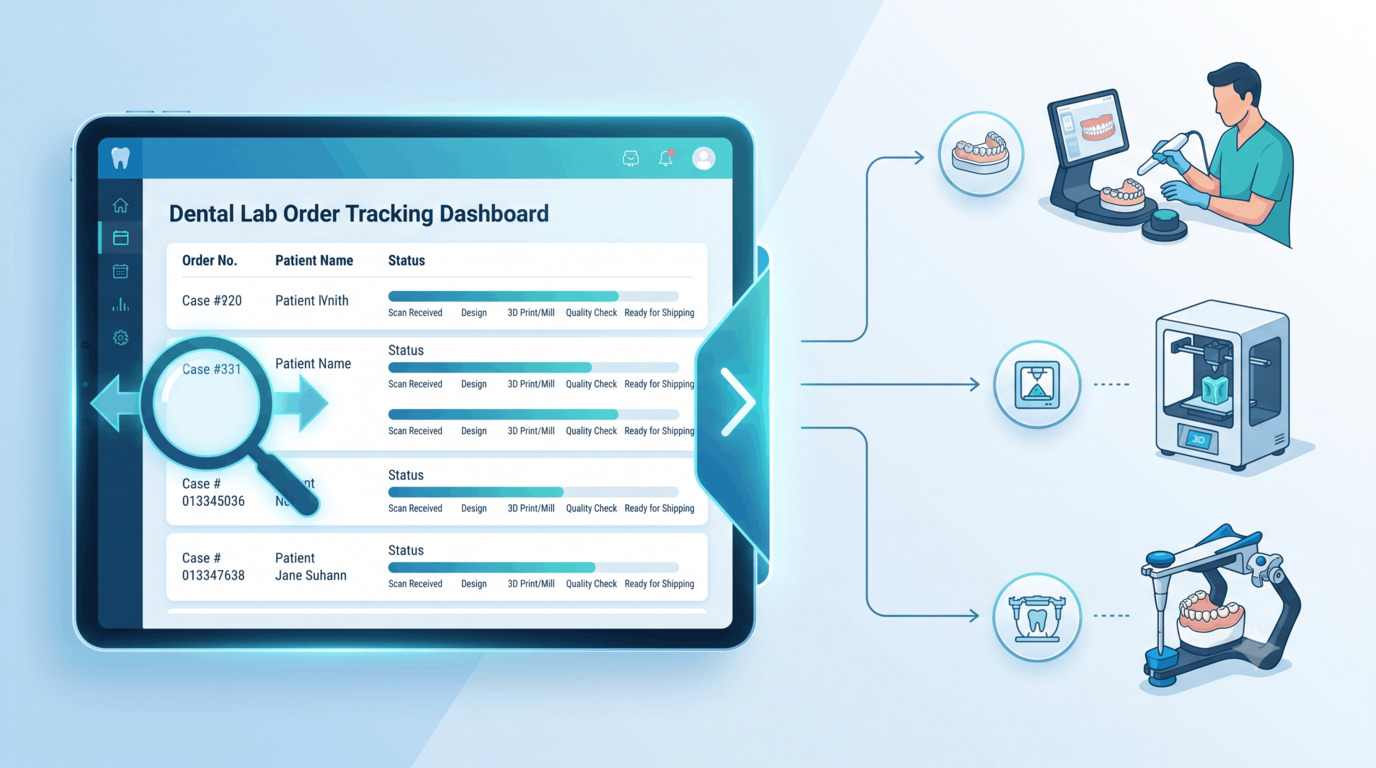
A patient calls to ask whether their crown is ready. It is a simple question, and in most clinics it starts a small search: someone checks a WhatsApp thread, someone else remembers the case went out on Tuesday, and eventually the lab gets a phone call.
The patient experiences this as a clinic that does not know what it is doing. It is not a clinical failure at all — it is a tracking failure — but the distinction is invisible from the waiting room.
Why lab work escapes the system
Every other part of a treatment lives in the clinic's own records. Lab work is the exception, because the lab is a separate business with its own process, and the shared surface between you is usually a messaging thread or a paper docket.
That arrangement is fine for sending a case. It is poor at answering questions about one:
- Which cases are currently out?
- Which are overdue against what that lab normally takes?
- What did we promise this patient, and can we still keep it?
- How many cases came back needing remake this quarter?
None of those need the lab's cooperation to answer. They only need your side recorded properly.
Turnaround is a per-lab, per-case-type number
A single average turnaround across all work is close to meaningless, because a night guard and a full-arch case are not the same job. Averaging them produces a figure that describes neither and flatters whichever lab does more of the simple work.
Track turnaround by lab and by case type. Two things become visible immediately:
Which lab is actually faster for the work you send most, rather than in general.
Which lab is consistent. This matters more than speed. A lab that reliably takes ten days is easier to run a clinic against than one averaging seven with a range of four to fourteen — because you can book the fitting appointment against ten and be right almost every time. Variance, not average, is what causes reschedules.
Remakes are a quality signal, not an embarrassment
Clinics under-record remakes, partly because they are unwelcome and partly because they get absorbed as "one of those things".
But a remake is expensive in a way the lab invoice never shows: the material, the chair time, a second appointment, and a patient whose confidence took a knock. If a lab is 15% cheaper and produces noticeably more remakes, it is not cheaper.
Recording them turns an irritation into a negotiating position. "Your remake rate on posterior crowns is roughly double the other lab we use" is a conversation that changes behaviour. A vague sense that a lab is unreliable is not.
What to hold, per lab
| Metric | Why it matters |
|---|---|
| Average turnaround, by case type | Booking the fitting appointment accurately |
| Variance in turnaround | Predictability — the thing that prevents reschedules |
| Remake / adjustment rate | The true cost hiding behind the price |
| Outstanding balance | What you owe, and what is disputed |
| Cases currently out | Answering the patient in seconds |
| Overdue against their own norm | Chasing before the patient has to ask |
The last row is the one that changes daily life. "Overdue" should mean late against that lab's own history for that case type, not against a flat number — otherwise the list is either full of false alarms or silent when it matters.
What to promise the patient, and when
Most reschedules trace back to a fitting appointment booked optimistically at the moment the case went out.
The discipline is simple: book against the lab's real historical turnaround for that case type, plus a buffer, rather than against the date quoted on the docket. It feels like adding delay. In practice it removes the far more expensive delay of a patient who took time off work, arrived, and had to be sent home.
How PDental handles it
PDental holds lab orders in the same system as the patient and the treatment, so a case is attached to the person waiting for it rather than tracked alongside them. That is what turns "is my crown ready?" into a lookup instead of a search.
The reporting is specific rather than a single lab screen: turnaround time and a status pipeline for what is out and where it has reached, a remake and adjustment report for quality, lab performance comparison for choosing between labs on evidence, and lab balances for the financial side. Because orders sit against the patient record, a delayed case surfaces next to the appointment it is going to affect — which is the point at which you can still do something about it.
Pair that with the inventory chain and the two operational failures patients actually notice — a missing material and a late case — are visible in the same place.
Where to start
Take last quarter's lab work and produce two numbers per lab: average turnaround by case type, and remake rate.
Most clinics using more than one lab find the ranking is not what they assumed, and that the cheaper lab is cheaper for a reason they had been paying for without measuring. That is usually enough to change where the next month's cases go.
Frequently asked questions
Why does lab status usually live outside the clinic system?
Because the lab is a separate business with its own process, so tracking tends to happen in whatever the two parties share — a WhatsApp thread, a paper docket, a phone call. That works until someone asks a question the thread cannot answer quickly, which is exactly when the patient is on the line.
Should a clinic track remake rates per lab?
Yes, and it is one of the most useful numbers you can hold. A remake costs you the material, the chair time and the patient's confidence, and none of that appears on the lab's invoice. Without the rate, you compare labs on price while paying the difference somewhere invisible.
What is a reasonable lab turnaround time to expect?
It varies by case type, which is exactly why an average across all work is misleading. Track turnaround per lab and per case type, then hold each lab to its own historical performance rather than to a number you assumed. What matters commercially is consistency — a predictable ten days beats an unpredictable seven.
How far ahead should the fitting appointment be booked?
Book it against that lab's real turnaround for that case type, plus a buffer, rather than against the date they quoted. Booking on the quote is how clinics end up rescheduling patients — and the reschedule costs more goodwill than the extra days ever would.