
Production Is a Promise. Collections Are the Cash.
A full schedule can still leave the clinic short on cash if payments are slow, balances age and reconciliation depends on manual follow-up. Here's how to tighten the workflow.
Published
Production is comforting because it is visible. The schedule was full. Treatment was delivered. The day had movement.
Cash flow is less forgiving. It asks a different question: how much of the work you already did has become usable money?
A clinic can grow production and still feel tight if collections lag behind. The treatment was done, the staff were paid, the materials were used, the rent is due, and the balance is still waiting on a patient, a payer or a spreadsheet.
That is why payment workflow deserves the same seriousness as clinical workflow.
Where cash slows down
Most collection problems do not begin with one large failure. They begin as small delays that repeat every day.
The balance is not clear at checkout
If reception has to ask the doctor, check the insurance file, review a discount and calculate a part-payment while the patient is standing there, the moment passes.
The patient leaves with "we'll send it later", and the clinic has converted a collection opportunity into a follow-up task.
Payments are posted after the fact
Manual posting creates a timing gap. During that gap, reports are wrong, balances look higher than they are, and staff may chase patients who already paid.
Even when the money is collected, late posting damages trust in the ledger.
Patient balances age quietly
Balances rarely become impossible to collect overnight. They move from fresh to awkward to doubtful while everyone is busy with newer work.
Once a balance is old enough that nobody remembers the conversation, collection becomes harder and more emotional. The clinic is no longer asking for payment; it is reopening a past appointment.
Insurance and patient collection are treated separately
Patients experience one bill. Clinics often manage two workflows: insurance first, patient balance later. If the remaining balance is not triggered as soon as insurance resolves, another delay begins.
The revenue cycle is one chain. Splitting it into unconnected tasks is how money falls between them.
The payment KPIs that matter
You do not need a complicated finance dashboard to see the problem. Start with seven numbers:
| KPI | What it reveals |
|---|---|
| Same-day collection rate | Whether checkout is doing its job |
| Patient A/R by age bucket | How quickly balances become risk |
| Insurance A/R by age bucket | Whether claims are being followed before they stall |
| Payment posting delay | Whether reports can be trusted today |
| Unapplied or mismatched payments | Whether reconciliation is creating hidden cleanup |
| Write-offs by reason | Whether discounts, bad debt or payer issues are driving loss |
| Balance discussed before checkout | Whether the patient was told while still present |
Each metric should lead to a queue. If patient balances over 30 days rise, who calls? If payment posting is late, who owns reconciliation? If insurance ageing grows, which claims are held and why?
The number matters only when it points to work.
Make payment easy while the patient is still engaged
Patients do not always delay payment because they refuse to pay. Often the clinic made payment inconvenient at the exact moment the patient was willing.
Good payment workflow is built around timing:
- The estimate is discussed before treatment where possible.
- The invoice is ready at checkout.
- Discounts, insurance portions and part-payments are visible.
- The patient can pay in the method they prefer.
- Any remaining balance has a clear follow-up date.
- The ledger updates immediately.
That is not aggressive collection. It is clarity.
Patients trust clinics more when the financial conversation is timely and specific. Surprise balances create tension because they feel like a second diagnosis delivered by the front desk.
Reconciliation should be boring
If reconciliation is dramatic, the workflow is broken.
Month-end should not require reconstructing which payments belong to which procedures, which discounts were approved, which receipts were partial, which claim paid, and which balance remains.
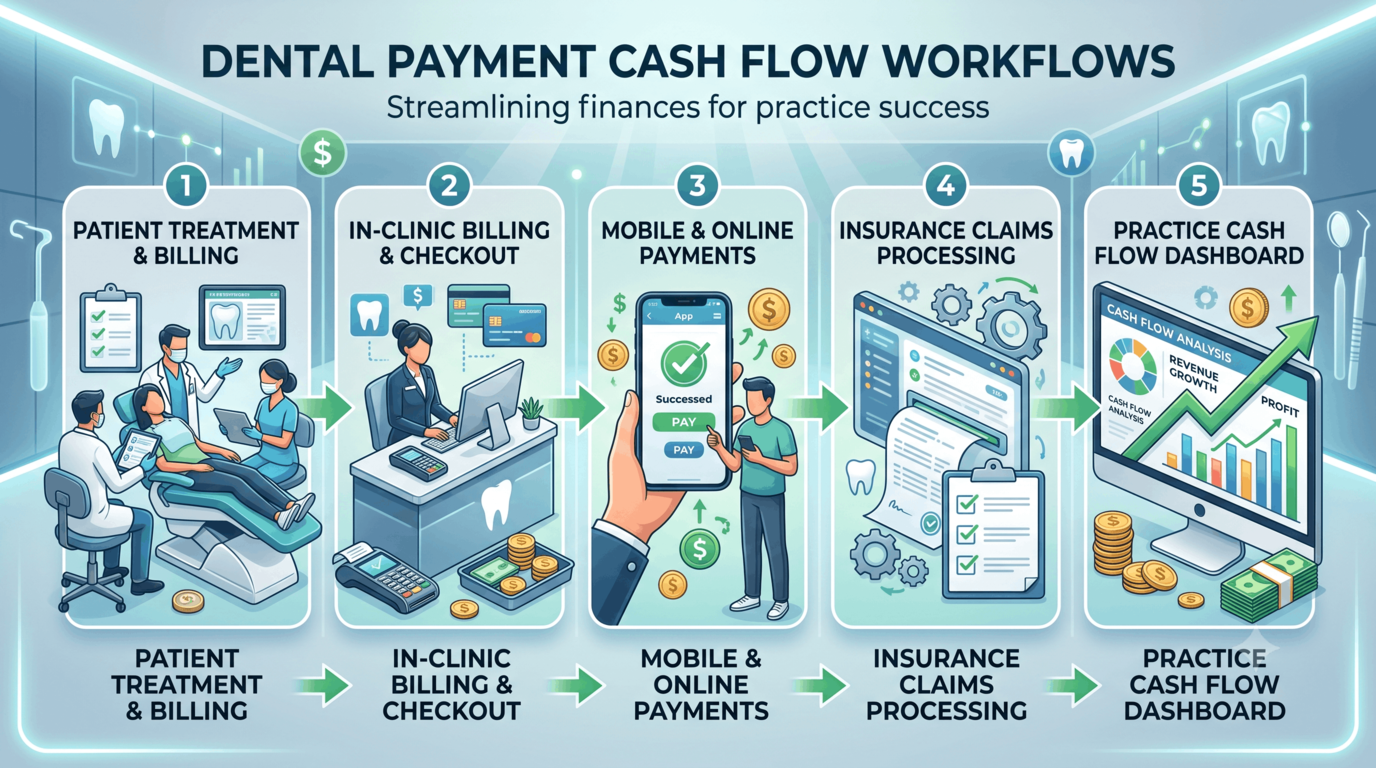
The cleaner model is procedure to invoice to payment to ledger to report, with each step connected. When payments are split, refunded, discounted or made in parts, the system should still preserve the chain.
That chain is what protects cash flow. It also protects staff time. Every payment that needs detective work steals attention from the next patient.
How PDental handles it
PDental connects billing, payments and reporting inside the patient workflow. Procedures flow into invoices, payment methods and part-payments are recorded against the patient ledger, and outstanding balances remain visible beside the clinical record rather than hidden in a separate finance tool.
For management, cash-flow and income-vs-expense reporting show whether production is turning into money the clinic can use. Patient balances, payments, discounts, doctor rates and insurance claims sit close enough together that finance can review what happened without rebuilding the month in a spreadsheet.
For the front desk, the practical benefit is simpler: when the patient reaches checkout, the team can see what was done, what was paid, what remains and what should happen next.
Where to start
Choose one week and track three things:
- How many patients left with a balance that was not discussed at checkout?
- How many payments were posted later than the day they were collected?
- How much patient A/R moved past 30 days?
Those numbers will show whether the problem is collection timing, posting discipline or follow-up. Fix the largest one first.
Production tells you the clinic was busy. Collections tell you whether the business can breathe.
Frequently asked questions
Why can a dental clinic have strong production but weak cash flow?
Production records the value of treatment delivered or planned. Cash flow depends on when money is collected, posted and reconciled. If patient balances age, insurance claims stall or payments are posted late, production can look healthy while cash remains tight.
What payment KPIs should a dental clinic watch?
Watch same-day collection rate, patient balances by age bucket, insurance ageing, unapplied payments, payment posting delay, write-offs and the share of appointments where a balance was discussed before checkout.
Should clinics collect at checkout?
Whenever the balance is known and clinically appropriate, yes. The easiest payment to collect is the one requested while the patient is present, the treatment is fresh and the amount is clear. Waiting turns a simple payment into a follow-up workflow.
How does software improve payment collection?
Software helps when it connects the procedure, invoice, payment, ledger and report. That reduces manual posting, makes balances visible at checkout, supports part-payments and gives managers an ageing view before balances become hard to collect.